fusanilab
Behaviour, Physiology & Ornithology
How do birds regulate seasonal expression of the migratory state? The gut hormone ghrelin could play a key role, suggests an experimental study in common quails
The seasonal expression and the migratory phenotype is signalled by rapid and marked changes in food intake, fuelling, and amount of nocturnality. We used common quails (Coturnix coturnix) to assess if the hormone corticosterone and the gut-derived hormone ghrelin play a role in these astonishing physiological transitions. We exposed quails to controlled changes in day length to simulate autumn migration, followed by a wintering period. We compared corticosterone and ghrelin concentrations and assessed whether these two metabolic hormones varied between distinct migratory states. We found that the expression of the migratory phenotype was associated with a sharp elevation in circulating concentrations of ghrelin. Interestingly, we also found that concentrations of ghrelin correlated with changes in body mass (fat stores) of birds as they transitioned into their autumnal migratory state and as they entered the wintering state. Contrary to our predictions we did not detect functional links between plasma corticosterone and the physiological state of the birds and we also did not observe a link between circulating levels of ghrelin and corticosterone.
The article “Ghrelin, not corticosterone, is associated with transitioning of phenotypic states in a migratory Galliform” by Valeria Marasco, Hiroyuki Kaiya, Gianni Pola & Leonida Fusani can be accessed here. You can also access here the Vetmeduni Press Release.
How do tropical birds cope with global warming?

A common potoo (Nyctibius griseus) perched on a wooden post next to a farm remains lethargic throughout the hottest hours of the day to cope with high environmental heat as well as arising hyperthermia.
The elevated, and seemingly low-variable, temperature conditions in the world’s tropical regions have long been considered as key factors for the biotic response to global warming, ringing the alarms in the scientific community. In the case of birds, however, empirical evidence has grown in the past decades contrasting the traditional notion of high physiological sensitivity to thermal variation. So, is it really getting too hot for birds in Tropics and, if so, how? In our integrative paper, we review published scientific literature and argue that tropical birds seem to have the capacity to handle thermal variation and high levels of heat, as shown during thermo-tolerance experiments. Nevertheless, their vulnerability under natural conditions might increase when considering the joint effects of high heat and humidity, plus the disturbance of natural habitats and the disruption of microclimates due to anthropogenic activities.
The paper “Physiologically vulnerable or resilient? Tropical birds, global warming, and redistributions” can be freely accessed (OA) through this link: https://onlinelibrary.wiley.com/doi/10.1002/ece3.9985
Modelling bird formations using fuzzy logic

This paper is the outcome of a long work trying to model bird formations, in particular line formations. In the scientific literature, there are several attempts to model flock of birds flying in a cluster (as for example those wonderful flocks of starling that look like dancing in the sky). However, about birds flying in line formation there is little as it is rather challenging to collect data.
In a collaborative project led by the Waldrappteam (https://www.waldrapp.eu/en/), we tracked a flock of Northern Bald Ibis (Geronticus eremita) during the human-guided migration south (read here to discover how we did it) and collected data on line formation.
Once the data was collected, we needed to classify when a bird was flying in the wake of another individual and when not. But first: what does it mean to “fly in the wake”? When a bird flies and flaps its wings, it produces vortexes of air behind itself: a downwash behind the body and two upwashes, in correspondence of the wingtips. If another bird position itself in order to catch the upwash, then it is flying in the wake of the other bird. It does so because it can gain lift and save some energy while flying. However, it is not so easy to determine where exactly these upwashes lie, how they develop, and their extent or limits because they do not have crisp boundaries, but fuzzy ones. Therefore, it is difficult to determine when a bird is exploiting the upwash and when not.
We decided to model these vortexes using fuzzy logic, which helps to model vague and uncertain concepts. In addition, the model allows to classify the bird as being in the wake (if it is exploiting any upwash) of another bird or not.
To the best of our knowledge, this is the first attempt in the scientific literature that tries to model line formations. Further steps will be to apply the model to investigate if birds that are flying in the wake are saving energy, to unveil pattern of movements while flying in formation, and to study social interactions and their influence during flight formation.
If you are interested in reading more on the model, check out the paper published in Journal of the Royal Society Interface “Characterization of bird formations using fuzzy modelling” , and stay tuned for updates!
New grant to implement novel feeding strategies on fish farms

The careful follower of the fusanilab knows that the interest of the group does not stop at birds and also extends to many other animals, especially when it comes to improving animal welfare. A group member, Stefan Fischer, currently received a grant from the Vienna Science and Technology Fund to improve animal welfare and the release success of commercial fish farms by implementing novel feeding strategies. In this 7- month project Stefan will work together with Assoc. Prof. Petter Tibblin, from Linnaeus University, Privatdoz. Dr. Sabine Tebbich, from the University of Vienna, and the head of the lab Prof. Leonida Fusani, to experimentally investigate and to raise the awareness of the consequences of different feeding regimes on stress responses in commercially raised fish. Normally commercial aqua-cultures use the logic of “more food equals more profit” which sometimes leads to overfeeding the individuals. However research on different animals, including humans, shows that over-nutrition may have massive negative physiological, behavioural and cognitive consequences. In their own work at the KLIVV, they could show that affluent fish had a reduced cognitive performance, in terms of behavioural flexibility, compared to lean fish. The aim of the project will be (1) to experimentally assess the impact of different feeding regimes on stress physiology and cognition in Atlantic salmon, one of the most important species produced in fish farms, and (2) to transfer the findings to stakeholders of aquaculture in Austria and Sweden to develop new feeding strategies for commercially reared fish. The team believes that this project is an important first step that could lead to massive economic, welfare and societal benefits for an economy that creates several hundred billion dollars a year.
Hybrid manakins do hybrid courtship
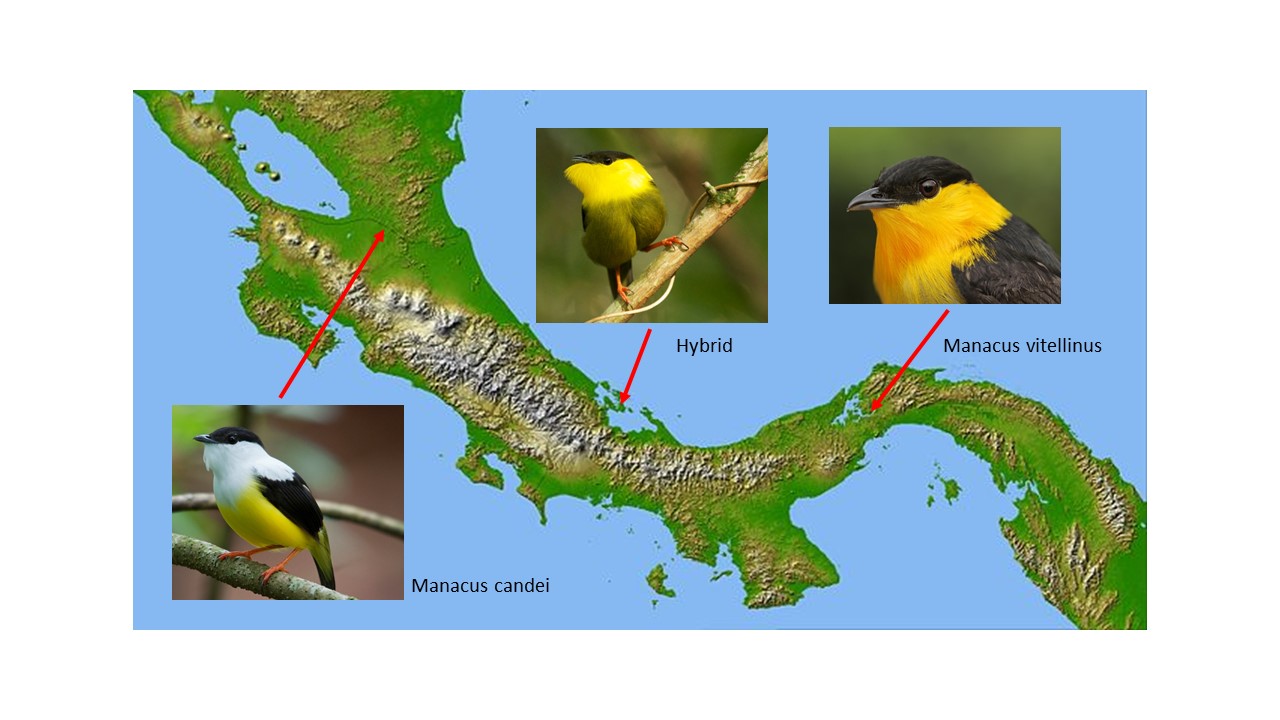
Research on hybridization has focused mostly on plumage, particularly in taxa like the bearded manakins Manacus spp. that differ from each other mainly for the colour of the collar and of the underparts. By using high-speed videography and slow-motion analysis, we found that hybrids perform courtship displays that are intermediate between the two parent species. In particular, the colour and the choreography show different degrees of similarity with either parent species, suggesting that courtship behaviour is involved in speciation processes in this avian taxon.
The article is in press and can be accessed here.
You can access the corrected proofs with the button below.
Claudia Janiczek wins the prize for the best poster at the PhD academy
Another recognition for our group: Claudia Janiczek won the prize for the best poster at the PhD Academy, an event organized by the CoBeNe Doctoral School of the University of Vienna. Claudia presented her work on the comparison of courtship displays between species of Birds of Paradise.
Christina Krumpholz wins the price for the best talk at the PhD academy

The PhD Academy was launched last year and is aimed primarily at PhD students from the CoBeNe Doctoral School of the University of Vienna. This year, our PhD student Christina Krumpholz gave a talk on the relative contribution of voice and face to person attractiveness in online experiments and in real-life settings, a study she has conducted within our project Comparative Aesthetics. She won the award for the best presentation at the conference!
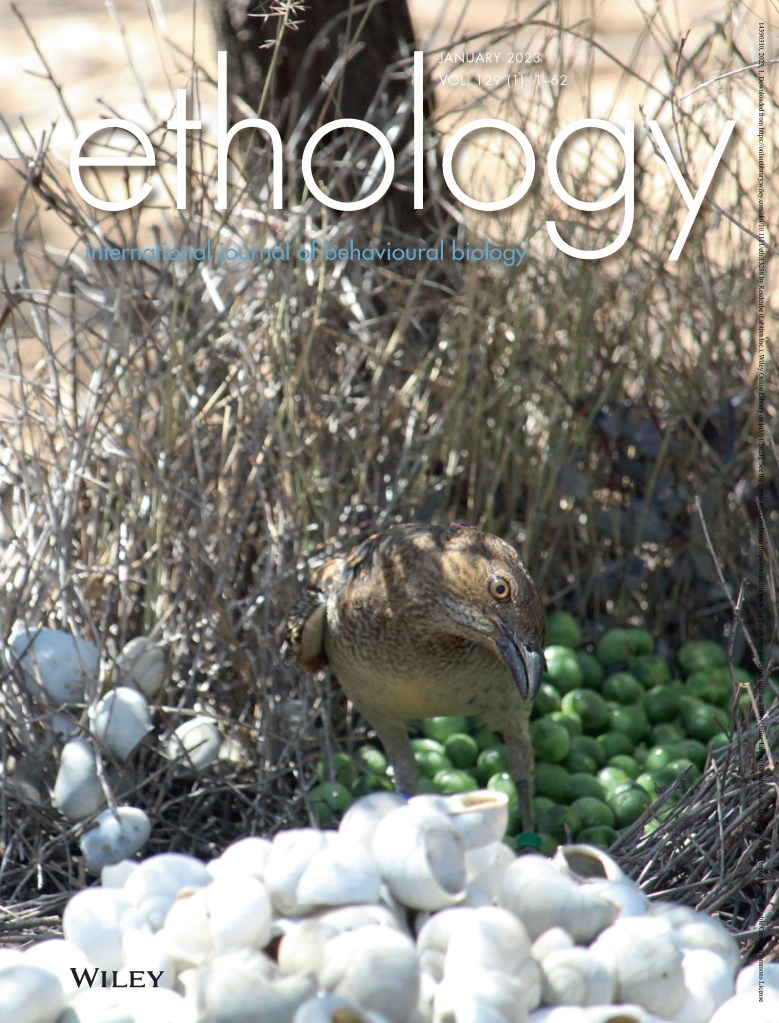
Cover Image for Ethology – Jan 2023

Our paper Sneaky copulations by ‘apprentices’ bowerbirds made the cover of the journal’s issue of January 2022. Nice to see our work portraited!
Article on reduction of migratory behaviour in Der Standard

If you can read German, have a look at the most recent interview released by Wolfgang Vogl on the disappearence of migratory behaviour in many species of migratory birds that remain in Europe in winter because of climate change.
Giovanni Spezie defended his PhD
After a few adventurous years, during which he had to face droughts, pandemics and wildfires, Giovanni eventually defended his PhD on December 6th. His contributiions on the courtship of bowerbirds and in general about the role of learning in the development of coursthip displays will leave a deep footprint in our lab. Bravo! You can find his publications here.

 fusanilab