Reproductive behaviours and decisions made by breeding shorebirds before and during reproduction can have profound effects on reproductive success: choose the wrong nest location or the wrong mate and reproduction could be destined for failure. Incubation and brood care are also integral behavioural components of any given breeding attempt. Perhaps less obvious are behaviours during the non-breeding period that can have strong influence over reproductive success, for example, foraging to attain body condition and fat reserves or social interactions with potential mates could promote later reproductive investment and opportunities. Each of these behaviours and decision-making processes are shaped by an individual’s interactions with its environment, which comprises both social structure among conspecifics and individual spatial movements and use of habitats.
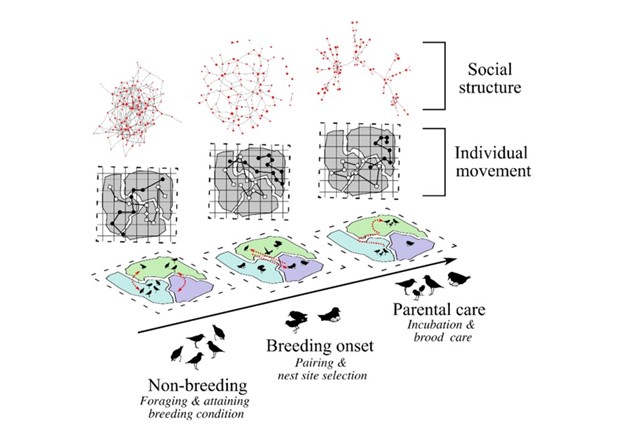
Figure 1. Key stages of reproduction as illustrated with a small shorebird, the Kentish plover. The ‘spatial-social interface’ of shorebirds that shapes each stage of reproduction emerges as a function of social structure and individual spatial movements across a landscape. (Image created by Grant McDonald).
With this project, we are investigating how environmental and social interactions jointly shape individual behaviour and parental success. We will determine the extent to which individual spatial and social phenotypes influence reproductive strategies and parental investment at different stages of reproduction – including pre-breeding, breeding onset and parental care stages (e.g. through resource acquisition, mate choice, nest choice, chick defence).
To achieve these objectives, we are studying a small shorebird, the Kentish plover (Charadrius alexandrinus), which has become a model species for studies of reproductive strategies. A long-studied breeding population of Kentish plovers in Maio, Cabo Verde, is the focus of the project, where in 2023 and 2024 we are deploying high-resolution GPS tags to breeding birds. This state-of-the-art animal tracking technology will be able to provide year-round information on the locations of multiple birds simultaneously at fine scales. Combining tracking data with novel social network analysis approaches will further determine the spatial and social phenotypes of individuals in the breeding population. For the first time, our study will provide new insights at the ‘spatial-social interface’ of individuals during both the breeding and non-breeding seasons, and ultimately how they influence reproductive decisions and success.
The pilot phase of the project has now been completed and individuals are already revealing new insights into their movement ecology. Some individuals have shown unexpected journeys between islands in the Cabo Verde archipelago, and others show nocturnal movements to inland and upland areas (possibly to rocky grassland foraging sites) that have never been documented before. These early data also highlight the potential conservation value of the project which may further reveal habitat use or annual migrations during the non-breeding season that were previously unknown, with implications for the protection of the population and their preferred habitats.
This project has been funded by FWF (I 6306-B), and is a joint project between the Universities of Veterinary Medicine in Vienna and Budapest, and with collaboration from the University of Bath, the Maio Biodiversity Foundation, and the support of Lantuna and the University of Cabo Verde.
Project participants:
András Kosztolanyi
Grant McDonald
 fusanilab