
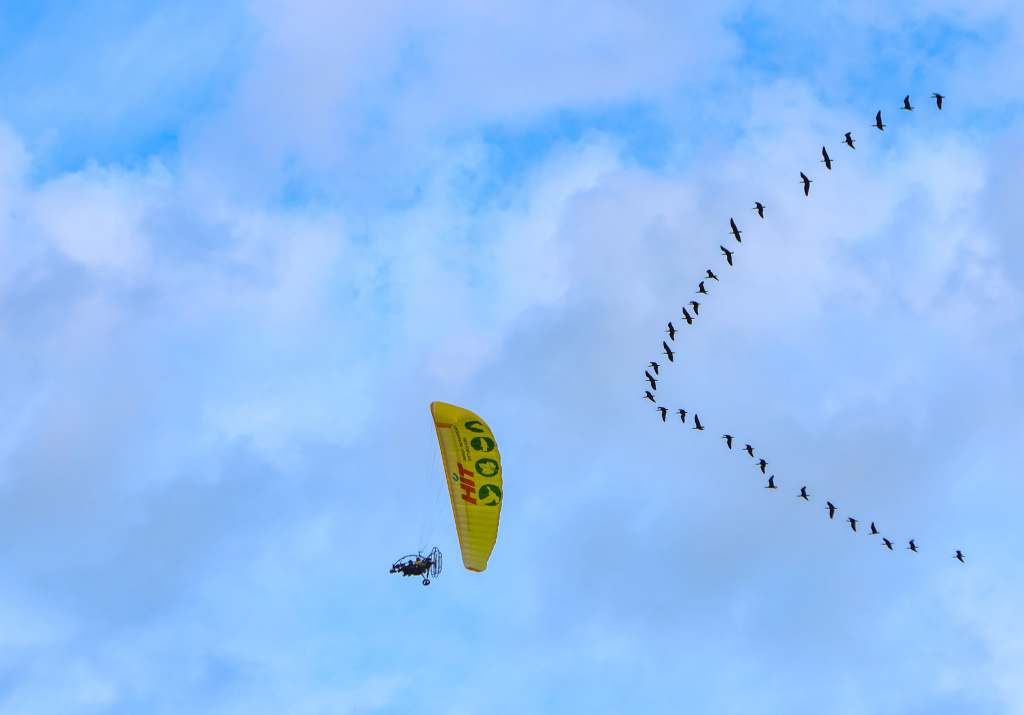
Every year we assist to one of the most wonderful animal journeys, bird migration. Many species of birds travel yearly from their wintering to their reproductive grounds and vice versa, sometimes flying for thousands of kilometers. Yet, migration is a strenuous trip for them to the point that some individuals perish. Therefore, birds evolved a series of behavioural and physiological adaptations, which can help them to face migration. Among the behavioural adaptations we can find flight strategies, such as formation flight.
During formation flight, birds fly in a structured flock that can resemble a line, a J or a V. This type of flight has always amazed biologists, who tried to understand why birds would fly in this way. The main hypothesis was that they can save metabolic energy by flying in the wake of another individual. However, evidence was scarce, especially with free-flying migrating birds.
We designed a study to measure if birds saved energy while flying in formation flight. We used as model species the Northern bald ibis (Geronticus eremita) and collected data on formation flight during a human-led migration with an entire flock of individuals. We collected data on their position in space, body acceleration and heart rate. After determining when birds flew in-wake (click here to learn how we did it) , we correlated this with heart rate frequency and dynamic body acceleration (an proxy for energy expenditure).
Our results show that birds saved energy, especially during flapping flight, but these savings are smaller than we expected. We observed a decrease in dynamic body acceleration and heart rate, the latter being rather variable across birds. In addition, we learnt that birds save energy most likely by skipping wingflaps, which means that they glide more when in-wake.
The article was published in Proceeding of Royal Society B and we invite interested readers to give it a look here.
 fusanilab